Publicado el

Beneficios del Ajedrez.

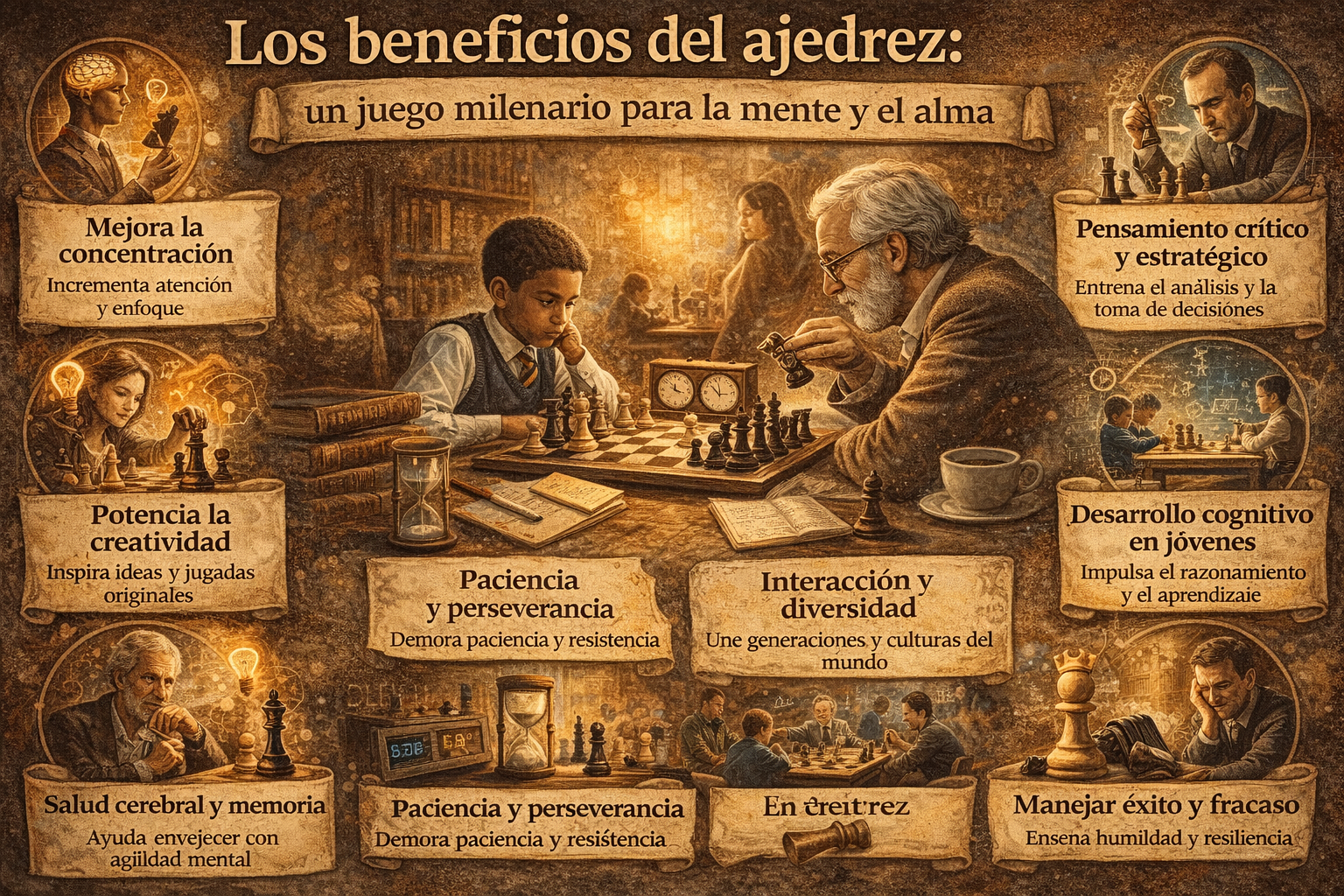
Los beneficios del ajedrez: un juego milenario para la mente y el alma

Concentración, pensamiento crítico, creatividad y comunidad: por qué el tablero sigue ganando en 2026.

El ajedrez no es solo un juego: es una disciplina intelectual con más de mil años de historia. Practicado en todas las culturas, ofrece beneficios que van más allá del tablero e impactan el desarrollo cognitivo, emocional y social.

Editorial Evil Chess El ajedrez te enseña algo brutalmente útil: pensar antes de mover. Y asumir las consecuencias sin excusas.

🧠Mejora la concentración

Entrena atención sostenida, lectura del tablero y control del impulso. Un descuido cambia todo.

♟️Pensamiento crítico y estratégico

Analizas opciones, anticipas consecuencias y tomas decisiones informadas bajo presión.

🎨Creatividad e imaginación

Reglas estrictas, ideas infinitas: combinaciones, planes raros, sacrificios y soluciones originales.

🧩Memoria y patrones

Mejoras memoria visual al reconocer estructuras, tácticas y finales recurrentes.

Paciencia y perseverancia

El ajedrez enseña que muchas ventajas se construyen lentamente: maniobras, profilaxis, y saber esperar el momento exacto. Aprendes a sostener un plan y a resistir posiciones difíciles.

👶Desarrollo cognitivo en niños y jóvenes

En etapas escolares, el ajedrez fortalece razonamiento lógico, comprensión lectora y hábitos de estudio. También impulsa disciplina, autoestima y manejo emocional al competir.

🧠Salud cerebral y envejecimiento activo

Mantener el cerebro activo con retos complejos ayuda a conservar agilidad mental. El ajedrez estimula atención, memoria y cálculo, y suele recomendarse como actividad intelectual a lo largo de la vida.

🌍Interacción social y comunidad

El tablero es un idioma universal: conecta generaciones y culturas. Clubes, torneos y partidas casuales crean comunidad basada en respeto y aprendizaje.

🧘Gestionar el éxito y el fracaso

Ganar y perder es parte del contrato. Aprendes a ganar sin soberbia y a perder sin drama: analizando, corrigiendo y regresando mejor.

“En ajedrez, como en la vida, el error es maestro… si te atreves a mirarlo de frente.” Y si no lo miras, lo repites.

🎮Entretenimiento y relajación

El ajedrez puede ser guerra o meditación: una forma divertida de retarte, desconectarte del ruido y entrar en flow.

Conclusión

El ajedrez fortalece mente y carácter: te hace pensar, decidir y aprender. Por eso sigue creciendo: porque en un mundo acelerado, el tablero te obliga a ir profundo.

Chess isn’t just a game—it’s an intellectual discipline with over a thousand years of history. Across cultures and generations, it delivers benefits beyond the board, shaping cognitive, emotional, and social skills.

Evil Chess editorial Chess teaches something brutally useful: think before you move—and own the consequences with zero excuses.

🧠Improves focus

Trains sustained attention, board awareness, and impulse control. One slip changes everything.

♟️Builds critical & strategic thinking

You evaluate options, predict outcomes, and make informed decisions under pressure.

🎨Boosts creativity

Strict rules, infinite ideas: combinations, unexpected plans, sacrifices, and original solutions.

🧩Strengthens memory & pattern recognition

Improves visual memory by recognizing recurring structures, tactics, and endgames.

Patience and perseverance

Chess teaches long-term advantage building: maneuvering, prophylaxis, and waiting for the exact moment. You learn to hold a plan and resist difficult positions.

👶Cognitive growth for kids and teens

In school years, chess supports logic, reading comprehension, and study habits. It also builds discipline, confidence, and emotional control through competition.

🧠Brain health and active aging

Keeping the brain challenged helps maintain mental agility. Chess trains attention, memory, and calculation— making it a lifelong mental workout.

🌍Social connection and community

The board is a universal language: it connects generations and cultures. Clubs and tournaments create communities built on respect and shared learning.

🧘Learning to handle wins and losses

Winning and losing is part of the deal. Chess teaches you to win without ego and lose without collapse: analyze, adjust, come back stronger.

“In chess, like in life, mistakes become teachers… if you dare to look at them.” If you don’t, you repeat them.

🎮Fun, challenge, and calm

Chess can be war or meditation: a way to challenge yourself, unplug from noise, and enter flow.

Conclusion

Chess strengthens mind and character: you think, decide, and learn. That’s why it keeps growing— because in a fast world, the board forces depth.
“`
Publicado el

Los Grandes Maestros del Ajedrez: ¿Quién es el Mejor Jugador de la Historia?

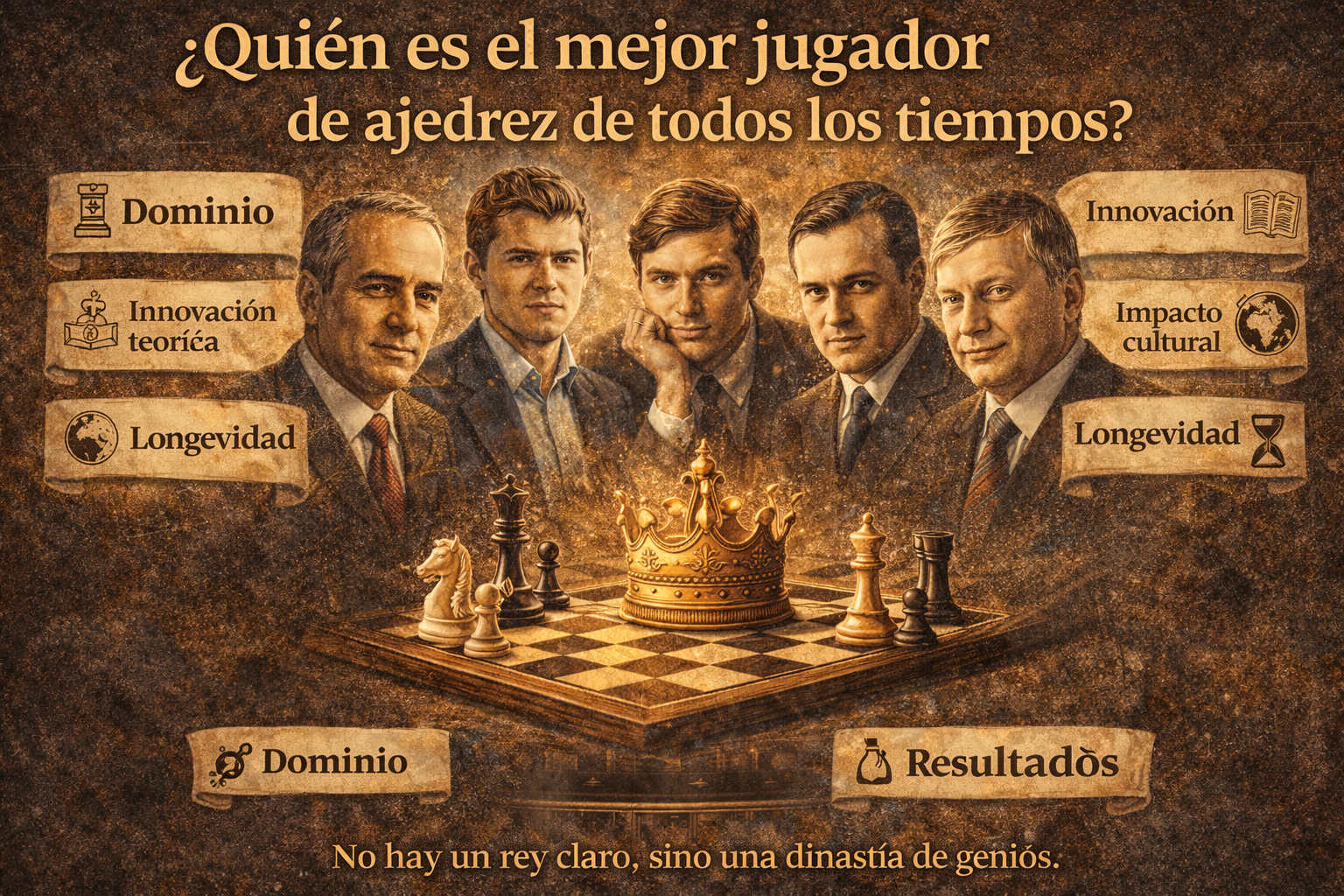
¿Quién es el mejor jugador de ajedrez de todos los tiempos?

El “GOAT” del ajedrez cambia según el lente: dominio, innovación, impacto cultural y longevidad.

Determinar quién es el mejor jugador de la historia del ajedrez es una pregunta tan fascinante como imposible de cerrar. El ajedrez evoluciona con la teoría, la tecnología y el contexto histórico. Por eso, cualquier respuesta depende de criterios como: dominio sobre los contemporáneos, innovación, impacto cultural, longevidad y consistencia.

Criterios clave Dominio · Innovación teórica · Impacto cultural · Longevidad · Adaptación a la era

Candidatos al trono

Garry Kasparov

El arquetipo del dominador absoluto

Campeón mundial desde 1985 y referencia moderna por agresividad, preparación profunda y una rivalidad legendaria con Karpov. También impulsó el uso sistemático de computadoras para análisis en la élite.

Magnus Carlsen

El dominio en la era moderna

El jugador total del siglo XXI: presión constante, intuición práctica y resultados de élite en clásico, rápido y blitz. Un maestro en convertir “nada” en ventaja.

Bobby Fischer

El genio solitario

Su match de 1972 contra Spassky redefinió el ajedrez como fenómeno cultural. Dominio aplastante en su pico, estándares de preparación más altos y un aura mítica que sigue intacta.

José Raúl Capablanca

La perfección hecha estilo

Elegancia, intuición y finales de precisión quirúrgica. En su apogeo parecía invencible: ganaba “sin ruido”, evitando errores con una claridad casi sobrenatural.

Anatoly Karpov

La precisión implacable

Control, profilaxis y explotación microscópica de debilidades. Ganaba asfixiando opciones, sin necesidad de fuegos artificiales. Una de las carreras más consistentes de la historia.

Otros nombres que entran a la conversación

Dinastía, no dueño único

Dependiendo del criterio, también aparecen figuras como Lasker, Alekhine, Botvinnik o Anand. El “mejor” cambia cuando cambia el tablero histórico.

No hay un solo rey eterno: hay una dinastía de mentes que empujaron el juego hacia adelante. Y cada época exige su propio tipo de grandeza.

Conclusión

Elegir al “mejor” depende del prisma: ¿dominio absoluto, talento puro, impacto cultural, longevidad, adaptación? Quizá la respuesta más honesta es esta: el ajedrez no tiene un GOAT indiscutible… tiene una historia llena de gigantes.

Picking the greatest chess player of all time is as fascinating as it is impossible to settle. Chess evolves with theory, technology, and historical context. So any answer depends on criteria such as: dominance over peers, theoretical innovation, cultural impact, longevity, consistency, and era adaptation.

Key criteria Dominance · Theoretical innovation · Cultural impact · Longevity · Era adaptation

Throne contenders

Garry Kasparov

The blueprint of dominance

World champion from 1985 and a modern benchmark for aggression, deep opening prep, and a legendary rivalry with Karpov. He also pushed systematic computer-aided analysis at the top level.

Magnus Carlsen

Modern-era supremacy

The complete player of the 21st century: relentless pressure, practical intuition, and elite results in classical, rapid, and blitz. A master at turning “nothing” into an edge.

Bobby Fischer

The lone genius

His 1972 match vs. Spassky turned chess into a global cultural moment. Peak dominance, raised preparation standards, and a mythic aura that still holds.

José Raúl Capablanca

Perfection as style

Elegance, intuition, and endgame precision. At his peak he looked nearly unbeatable—winning “quietly” with clarity that felt almost supernatural.

Anatoly Karpov

Relentless precision

Control, prophylaxis, and microscopic exploitation of weaknesses. He won by suffocating options—no fireworks required. One of the most consistent careers ever.

Other names in the conversation

A dynasty, not a single owner

Depending on the lens, legends like Lasker, Alekhine, Botvinnik, or Anand enter the debate. “Greatest” shifts as history shifts.

There’s no single eternal king—there’s a dynasty of minds that pushed the game forward. And every era demands its own kind of greatness.

Conclusion

The GOAT depends on the lens: absolute dominance, raw talent, cultural impact, longevity, adaptation? Maybe the most honest answer is this: chess doesn’t have one undisputed GOAT… it has a history full of giants.

Publicado el

Historia del ajedrez.

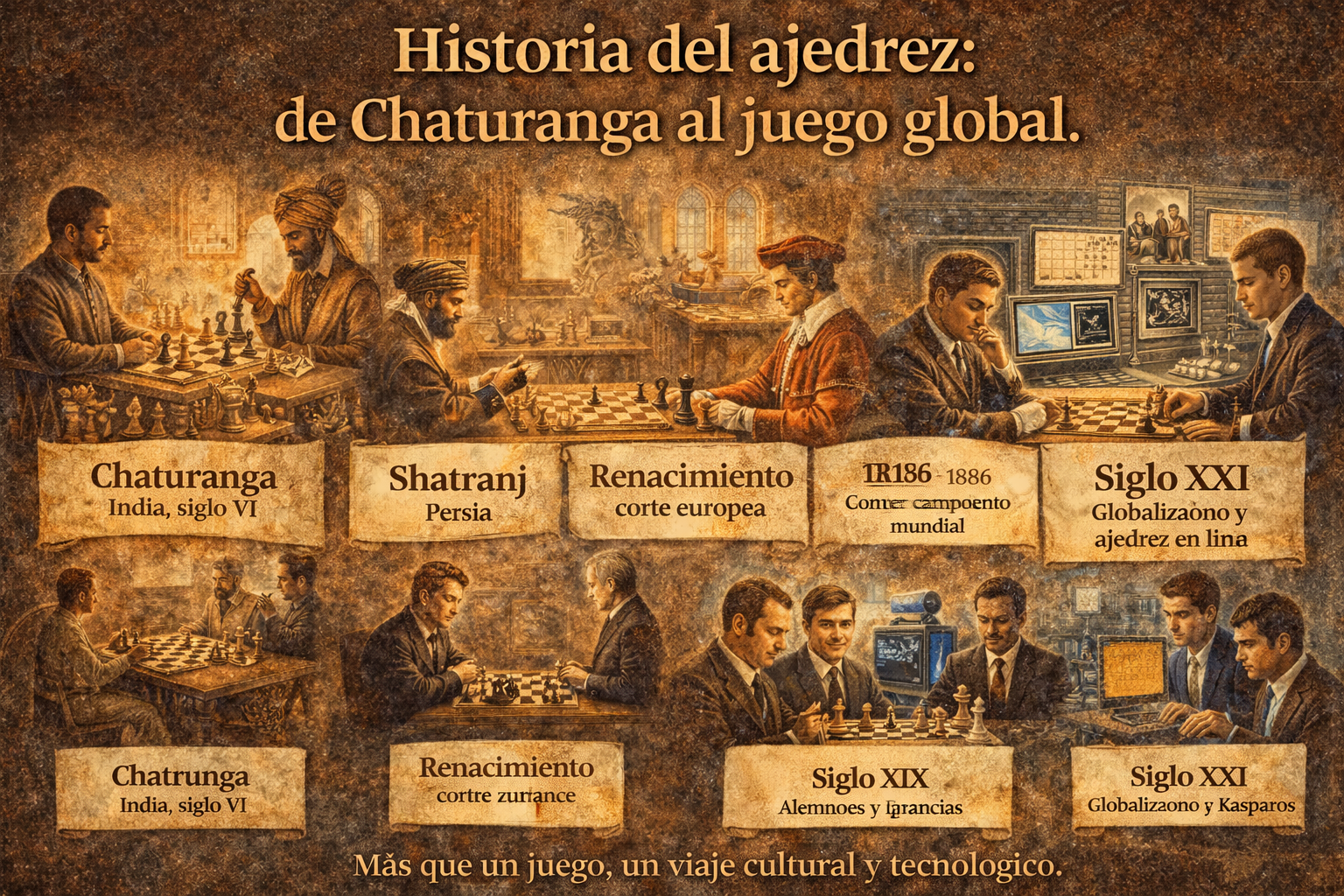
Historia del ajedrez: de Chaturanga al juego global

Un viaje cultural y tecnológico: guerra simbólica, cortes europeas, campeones, motores e internet.

La historia del ajedrez es un mapa de la humanidad: intercambio cultural, adaptación y progreso tecnológico. Desde el Chaturanga en la India hasta el ajedrez en línea del siglo XXI, el tablero ha sido espejo de guerra, filosofía y arte.

Idea central El ajedrez cambia con cada época, pero su núcleo permanece: decisión, consecuencia y creatividad bajo reglas.

Orígenes e historia temprana

Nacimiento del Chaturanga (India, siglo VI)

El ajedrez surge alrededor del siglo VI d.C. como Chaturanga (“cuatro divisiones del ejército”). Se jugaba sobre un tablero de 8×8 y representaba una batalla simbólica entre dos fuerzas.

  • Infantería → peón
  • Caballería → caballo
  • Elefantes → antecedente del alfil
  • Carros → torre

Evolución en Persia: Shatranj

Con rutas comerciales y expansión cultural, el juego llega a Persia y se convierte en Shatranj. En esta etapa se afianzan reglas y conceptos como el jaque/jaque mate, se clarifican movimientos clave (como el del caballo) y se consolidan estructuras de juego que influirán en Europa.

Expansión al mundo islámico y Europa

Tras la conquista árabe de Persia, el Shatranj se difunde por el mundo islámico y llega a Europa, especialmente a través de la península ibérica. Tratadistas y jugadores preservan y enriquecen el juego, y Europa comienza a reinterpretarlo según su propia cultura.

La revolución del siglo XV

En Europa, durante el siglo XV, el ajedrez se transforma: la reina adquiere su poder actual y el alfil amplía su alcance. El ritmo se acelera y el juego se vuelve más táctico y explosivo: nace el ajedrez moderno.

Del Renacimiento a la era moderna

Renacimiento · Ajedrez en la corte

El ajedrez se vuelve símbolo de cultura y refinamiento. Surgen tratados que sistematizan ideas de estrategia y táctica.

Siglo XVIII · Cambio de centro

El foco se desplaza de España/Italia a Francia y luego a Inglaterra y Alemania. Philidor destaca con ideas posicionales, famosa su visión de que “los peones son el alma del ajedrez”.

Siglo XIX: organización y primeros campeones

El ajedrez se institucionaliza: nacen clubes, se estandarizan reglas y se vuelven comunes los torneos internacionales. En 1886, Wilhelm Steinitz se convierte en el primer campeón mundial oficial, impulsando el ajedrez “científico”.

Siglo XX: teoría, campeones y computadoras

El siglo XX consolida una dinastía de campeones (Capablanca, Alekhine, Botvinnik, Fischer, Kasparov) y una expansión teórica enorme, especialmente en aperturas y planes posicionales. Hacia el final del siglo, la tecnología cambia el tablero: las máquinas entran al juego.

Hito tecnológico 1997: Deep Blue derrota a Kasparov y la conversación IA vs humano se vuelve global.

Siglo XXI: globalización y ajedrez en línea

Hoy el ajedrez es un fenómeno global. Campeones de distintas regiones dominan la escena y el ajedrez en línea democratiza el acceso: jugar, estudiar y analizar está al alcance de cualquiera con internet.

  • Plataformas digitales y comunidades masivas.
  • Motores y bases de datos como herramientas cotidianas.
  • Educación: cursos, streamers, análisis y contenido gratuito.
El ajedrez cambió de nombre, de imperios y de tecnología… pero no cambió su esencia: pensar antes de mover. Una guerra simbólica que nunca termina.

Conclusión

La historia del ajedrez es un viaje de adaptación cultural y evolución tecnológica. Del Chaturanga al mundo online, el juego sigue vivo porque combina arte, ciencia y estrategia en un formato eterno.

The history of chess is a map of humanity: cultural exchange, adaptation, and technological progress. From Chaturanga in India to online chess today, the board has mirrored war, philosophy, and art.

Core idea Chess changes with every era, but its core remains: decision, consequence, and creativity under rules.

Origins and early history

Chaturanga is born (India, 6th century)

Chess emerges around the 6th century CE as Chaturanga (“four divisions of the army”). Played on an 8×8 board, it represented a symbolic battle between two forces.

  • Infantry → pawn
  • Cavalry → knight
  • War elephants → bishop ancestor
  • Chariots → rook

Persia: the Shatranj era

Through trade routes and cultural expansion, the game reaches Persia and becomes Shatranj. Key rules and concepts solidify, including check/checkmate logic, clearer movement conventions, and structures that later shaped Europe.

Spread into the Islamic world and Europe

After the Arab conquest of Persia, Shatranj spreads across the Islamic world and reaches Europe, notably through Iberia. Scholars preserve and enrich the game, while Europe gradually reinterprets it through its own cultural lens.

The 15th-century revolution

In Europe, during the 15th century, chess transforms: the queen gains her modern power and the bishop extends its reach. The tempo accelerates and the game becomes sharper—modern chess is born.

From the Renaissance to modernity

Renaissance · Chess at court

Chess becomes a symbol of culture and refinement. Treatises systematize strategic and tactical ideas.

18th century · The center shifts

The chess world shifts from Spain/Italy to France, then to England and Germany. Philidor advances positional thinking, famously emphasizing the role of pawns.

19th century: organization and early champions

Chess becomes institutionalized: clubs appear, rules standardize, and international tournaments flourish. In 1886, Wilhelm Steinitz becomes the first official world champion, promoting a “scientific” approach.

20th century: theory, champions, and computers

The 20th century builds a dynasty of champions (Capablanca, Alekhine, Botvinnik, Fischer, Kasparov) and massive theoretical growth, especially in openings and positional planning. By the century’s end, technology reshapes the board: machines enter the arena.

Tech milestone 1997: Deep Blue defeats Kasparov and the AI-vs-human conversation goes global.

21st century: globalization and online chess

Today chess is truly global. Champions from many regions dominate, and online platforms democratize access: playing, studying, and analyzing is available to anyone with an internet connection.

  • Massive digital communities and platforms.
  • Engines and databases as everyday tools.
  • Education: courses, streamers, analysis, and free content.
Chess changed names, empires, and technology… but not its essence: think before you move. A symbolic war that never ends.

Conclusion

Chess history is a journey of cultural adaptation and technological evolution. From Chaturanga to online chess, the game remains alive because it blends art, science, and strategy into something timeless.