
Publicado el

FIDE: La Federación Internacional de Ajedrez y su Impacto Global

FIDE: la organización que rige el ajedrez mundial

Historia, estructura, torneos, títulos y los retos que han marcado su gobernanza.

Orígenes y evolución

La Federación Internacional de Ajedrez (FIDE) es la organización que gobierna el ajedrez a nivel mundial. Fue fundada en 1924 en París, Francia, y su lema es “Gens una sumus”, en latín: “Somos una familia”. Su creación respondió a una necesidad clara: unificar reglas, organizar campeonatos de alcance global y promover el ajedrez como deporte y cultura.

“Gens una sumus” — Somos una familia. El lema resume la intención: un idioma común para un juego universal.

Estructura y funcionamiento

La FIDE está compuesta por federaciones nacionales de más de 180 países. Cada federación organiza el ajedrez en su territorio y colabora con FIDE en eventos y calendarios internacionales. La organización se rige por un Congreso, donde se discuten decisiones relevantes y se elige a la junta directiva, incluido el presidente.

En pocas palabras Si el ajedrez fuera una liga global, la FIDE sería el organismo que define las reglas, valida los eventos y certifica los logros oficiales.

Torneos y campeonatos

La FIDE organiza y supervisa torneos de alto perfil, incluido el Campeonato Mundial de Ajedrez. También coordina las Olimpiadas de Ajedrez, un evento bienal donde compiten equipos de todo el planeta. Además, la FIDE otorga títulos oficiales que funcionan como “rango” internacional: GM, IM, FM, entre otros.

  • Campeonato Mundial: la cúspide competitiva individual.
  • Olimpiadas: el gran escenario por equipos (selecciones nacionales).
  • Títulos: credenciales reconocidas globalmente por rating, normas o resultados oficiales.

Promoción y desarrollo del ajedrez

Una misión clave de la FIDE es impulsar el ajedrez como herramienta educativa y cultural. Mediante programas como “Ajedrez en la Escuela”, busca integrar el juego en entornos formativos para desarrollar habilidades como pensamiento crítico, atención y resolución de problemas. También promueve la accesibilidad y la participación de grupos subrepresentados, incluyendo mujeres y jóvenes.

Desafíos y controversias

Como toda institución global, la FIDE ha enfrentado controversias a lo largo de los años: disputas políticas, conflictos de interés y acusaciones de corrupción han alimentado debates sobre gobernanza y transparencia. Aun así, la FIDE continúa adaptando su estructura y prácticas con el objetivo de fortalecer el futuro del ajedrez.

Conclusión

La FIDE juega un papel crucial en el ajedrez mundial: define marcos oficiales, organiza competencias, otorga títulos y promueve el crecimiento del juego. Con retos y todo, su existencia permite que el ajedrez se mantenga como un deporte intelectual con reglas comunes y proyección global.

Origins and evolution

The International Chess Federation (FIDE) is the global organization that governs chess. It was founded in 1924 in Paris, France, and its motto is “Gens una sumus”— Latin for “We are one family.” FIDE was created to unify chess rules, organize world-level championships, and promote chess worldwide as both sport and culture.

“Gens una sumus” — We are one family. The motto captures the mission: one shared language for a universal game.

Structure and governance

FIDE is made up of national chess federations from more than 180 countries. Each federation runs chess activities locally and collaborates with FIDE on international events. The organization is governed through a Congress, where major decisions are made and the leadership is elected, including the FIDE President.

In plain terms If chess were a global league, FIDE would be the body that defines rules, validates official events, and certifies titles.

Tournaments and championships

FIDE organizes and supervises major competitions, including the World Chess Championship. It also oversees the Chess Olympiad, a biennial team event featuring national squads from around the world. In addition, FIDE awards official titles that serve as international credentials: GM, IM, FM, and more.

  • World Championship: the highest individual competitive stage.
  • Olympiad: the flagship team event (national selections).
  • Titles: globally recognized credentials via rating, norms, or direct-title routes.

Promotion and development

One of FIDE’s key missions is promoting chess as an educational and cultural tool. Through programs like “Chess in Schools”, it encourages chess in educational settings to support skills such as critical thinking, focus, and problem-solving. FIDE also works to make chess more accessible and to expand participation among underrepresented groups, including women and youth.

Challenges and controversies

Like many global institutions, FIDE has faced controversies over the years—political disputes, conflicts of interest, and corruption allegations have driven debates about governance and transparency. Even so, FIDE continues to evolve its structures and practices in order to support chess’s long-term future.

Conclusion

FIDE plays a crucial role in world chess: it sets official frameworks, runs competitions, awards titles, and promotes growth. With all its challenges, its existence helps chess thrive as an intellectual sport with shared rules and global reach.
Publicado el

El Aumento del Cheating en el Ajedrez

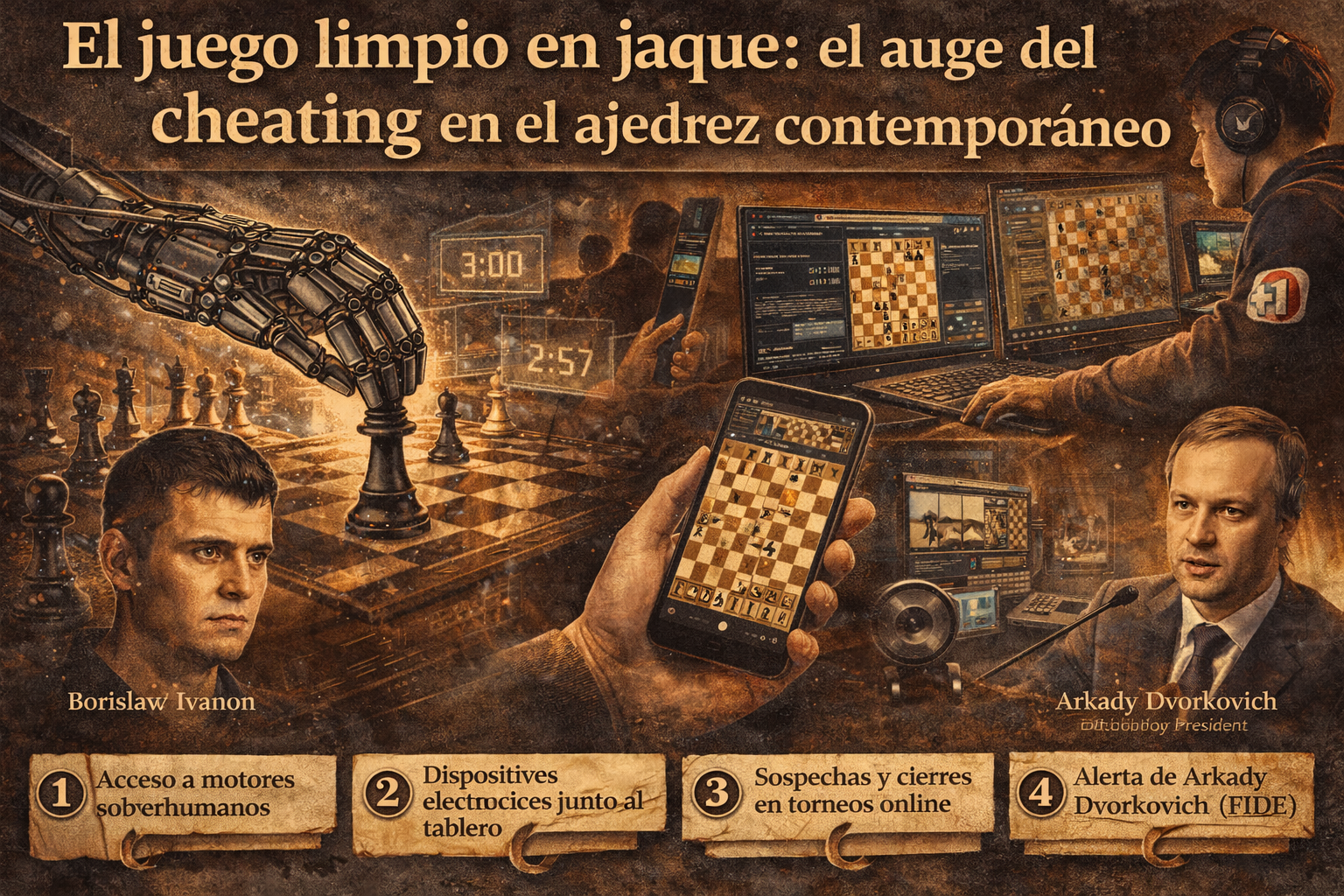
El juego limpio en jaque: el auge del cheating en el ajedrez contemporáneo

Tecnología, fraude asistido y el dilema de preservar un juego humano en tiempos de máquinas.

Durante siglos, el ajedrez se sostuvo sobre una promesa simple: la batalla ocurre únicamente en el tablero. Pero en el siglo XXI, esa promesa enfrenta un enemigo silencioso: el cheating (fraude asistido por tecnología), especialmente en el ecosistema online.

Idea central El problema no es solo “hacer trampa”: es erosionar la confianza. Sin confianza, el ajedrez deja de ser competencia y se vuelve sospecha.

Tecnología: aliada y amenaza

Motores de análisis de fuerza sobrehumana, bases de datos gigantes y plataformas accesibles han elevado el nivel global del juego. Hoy cualquiera puede entrenar como antes entrenaban solo los campeones. El costo: esas mismas herramientas facilitan el fraude.

  • Uso de motores durante partidas online.
  • Comunicación con terceros en tiempo real.
  • Dispositivos electrónicos ocultos en torneos presenciales.
  • Rendimientos “imposibles” estadísticamente sin asistencia.

Casos notorios y alertas desde la élite

El ajedrez no ha sido ajeno a escándalos y señalamientos. Ciertos casos de alto perfil han encendido debates sobre controles, reputaciones y transparencia: ¿cómo sancionar con rigor sin condenar sin evidencia suficiente?

El fraude no solo roba puntos: roba sentido. Porque el ajedrez es un contrato: “te gano con mi mente, no con una máquina”.

Medidas de prevención: una carrera constante

Para combatir el cheating, organizadores y plataformas han endurecido protocolos. El reto es que el fraude evoluciona al mismo ritmo que las defensas.

En torneos presenciales

  • Detectores de metales y revisiones aleatorias.
  • Prohibición total de dispositivos electrónicos en sala.
  • Zonas de juego aisladas y control de accesos.
  • Árbitros y oficiales especializados en anticheating.

En ajedrez online

  • Modelos estadísticos para detectar coincidencia con motores.
  • Revisión humana complementaria (no solo automatizada).
  • Verificación de identidad y monitoreo en eventos oficiales.
  • Controles de entorno (cámara, pantalla compartida, etc.) en torneos selectos.

El dilema ético: ¿control absoluto o confianza?

La pregunta de fondo es incómoda: ¿debemos normalizar la vigilancia constante para garantizar juego limpio? ¿O aceptar un margen de riesgo para preservar la esencia del ajedrez como duelo humano?

La discusión no es solo técnica, es filosófica: el ajedrez nació como disciplina mental. Si el resultado depende de la mejor máquina, el juego deja de ser ajedrez… y se vuelve “quién oculta mejor el motor”.

Conclusión

El cheating es uno de los mayores desafíos del ajedrez moderno. La tecnología expandió el juego, pero también puso a prueba sus valores. El futuro depende de equilibrar innovación, vigilancia y ética sin romper lo más importante: la confianza que hace que una partida valga la pena.

For centuries, chess lived on a simple promise: the battle happens only on the board. In the 21st century, that promise faces a quiet enemy: cheating—technology-assisted fraud, especially within the online ecosystem.

Core idea The problem isn’t just “breaking rules”—it’s eroding trust. Without trust, chess stops being competition and becomes suspicion.

Technology: ally and threat

Superhuman engines, massive databases, and easy-access platforms have raised the global level of play. Anyone can train like yesterday’s champions. The downside: the same tools enable fraud.

  • Using engines during online games.
  • Real-time help from a third party.
  • Hidden electronic devices in over-the-board events.
  • Statistically “impossible” performance without assistance.

Notable cases and elite-level warnings

Chess has seen scandals and allegations that sparked major debates about controls, reputations, and transparency: how do we punish decisively without condemning without solid evidence?

Cheating doesn’t only steal points—it steals meaning. Because chess is a contract: “I beat you with my mind, not with a machine.”

Prevention: an endless arms race

Organizers and platforms have strengthened protocols. The challenge is simple: cheating evolves as fast as the defenses.

Over-the-board measures

  • Metal detectors and random checks.
  • Strict bans on electronics in the playing area.
  • Isolated playing zones and controlled access.
  • Specialized anti-cheating officials.

Online measures

  • Statistical models to detect engine correlation.
  • Human review alongside automated systems.
  • Identity checks and monitoring for official events.
  • Environment controls (camera, screen sharing) in select tournaments.

The ethical dilemma: total surveillance or trust?

The uncomfortable question: should chess embrace constant monitoring to guarantee fairness? Or accept some risk to preserve chess as a fundamentally human contest?

This isn’t just technical—it’s philosophical. If the outcome depends on the best engine, chess stops being chess and becomes “who hides the engine better.”

Conclusion

Cheating is one of modern chess’s biggest challenges. Technology expanded the game, but tested its values. The future depends on balancing innovation, enforcement, and ethics—without breaking the most important piece on the board: trust.