
Títulos y rangos en ajedrez: qué significan (FIDE)
Una guía rápida para entender MF, MI, GM y títulos femeninos: requisitos de Elo y por qué importan.
El ajedrez es un juego milenario que ha evolucionado a lo largo de los siglos, y con él también ha cambiado la forma en que se reconocen y clasifican las habilidades de sus jugadores. En el mundo del ajedrez existen títulos y rangos que ayudan a medir la destreza competitiva. Estos títulos son otorgados por la Federación Internacional de Ajedrez (FIDE) y se reconocen a nivel mundial.
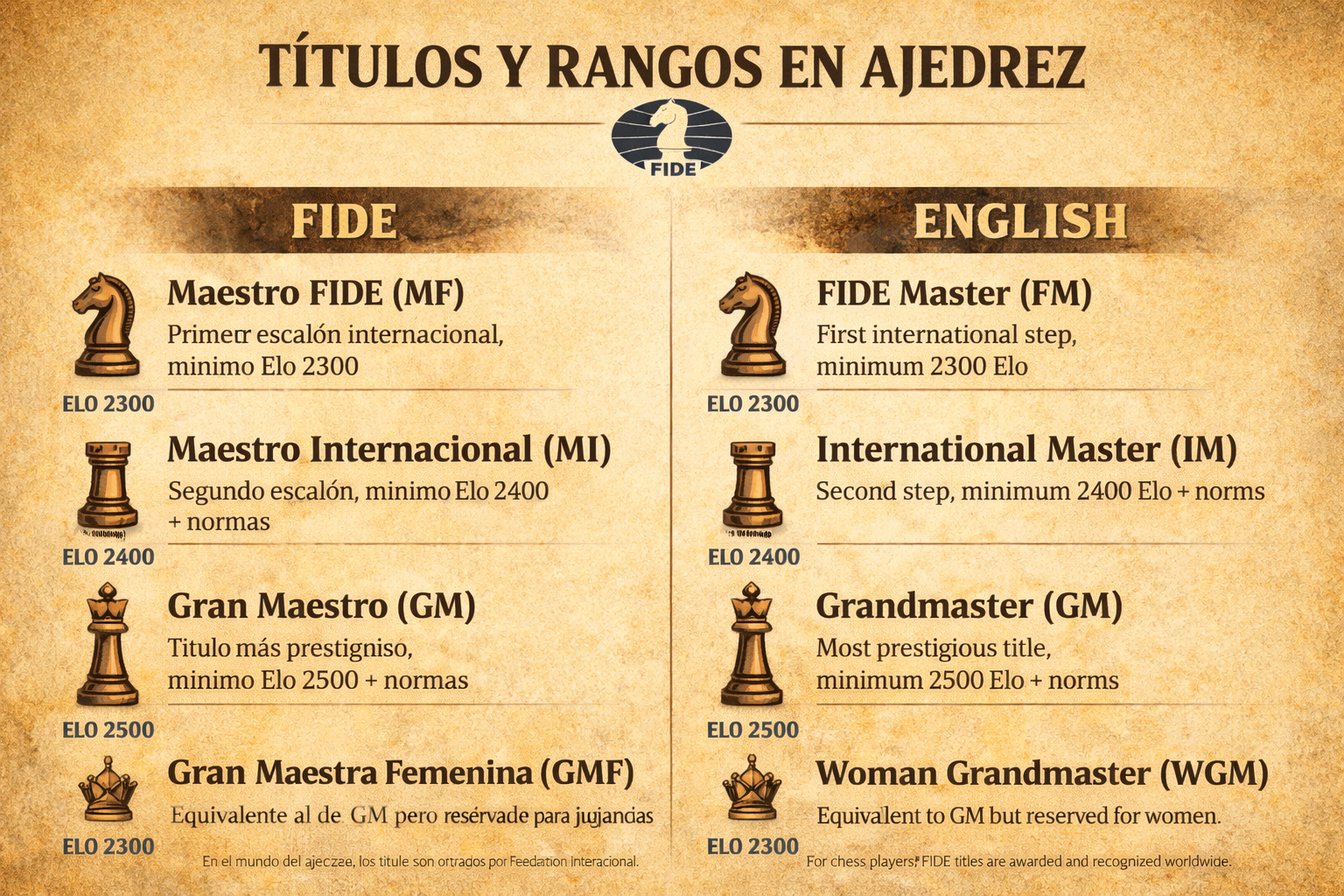
Maestro FIDE (MF)
El título de Maestro FIDE es uno de los primeros escalones en la jerarquía internacional. Para obtenerlo, el jugador debe alcanzar un Elo mínimo de 2300. Quienes lo poseen han demostrado un nivel sólido y suelen competir regularmente en torneos internacionales.
Maestro Internacional (MI)
El título de Maestro Internacional es un paso más alto. Generalmente requiere un Elo mínimo de 2400 y cumplir con requisitos de rendimiento en torneos internacionales (normas o criterios equivalentes según reglamentación). Los MI son jugadores de alto nivel, capaces de competir con fuerza en el circuito internacional.
Gran Maestro (GM)
El título de Gran Maestro es el más prestigioso del ajedrez. Para ser reconocido como GM, se exige un Elo mínimo de 2500 y criterios de rendimiento aún más estrictos en competiciones internacionales. Los GM forman la élite: compiten en los torneos más fuertes del mundo y marcan tendencia en teoría y práctica.
Gran Maestra Femenina (GMF / WGM)
Este título está reservado para jugadoras. Es un reconocimiento de máximo nivel dentro de la rama femenina. Las Grandes Maestras Femeninas suelen requerir un Elo mínimo de 2300 y cumplir requisitos de rendimiento en torneos internacionales femeninos.
Otros títulos
Además de los títulos principales, existen otros reconocimientos como el Maestro Internacional Femenino (MIF / WIM), el Maestro FIDE Femenino (MFF / WFM) y títulos por categorías de edad, por ejemplo juveniles según eventos y federaciones.
Conclusión
El camino hacia estos títulos es arduo y requiere dedicación, estudio y competencia real. Cada rango es, en esencia, una certificación del trabajo acumulado y del amor por el juego: una forma de decir “ya jugué contra lo mejor… y sigo de pie”.
Chess is an ancient game that has evolved over centuries—and so has the way we recognize and classify player strength. In the chess world, there are several titles and ranks used to measure a player’s competitive level. These titles are awarded by FIDE and are recognized worldwide.
FIDE Master (FM)
The FIDE Master title is one of the first major steps in the international title ladder. To obtain it, a player typically needs a minimum rating of 2300 Elo. FM holders have proven solid playing strength and often compete regularly in international events.
International Master (IM)
The International Master title is a step above. It generally requires a 2400 Elo minimum plus international performance requirements (norms or equivalent criteria depending on regulations). IMs are high-level players capable of competing strongly on the international circuit.
Grandmaster (GM)
Grandmaster is the most prestigious title in chess. To be recognized as a GM, a player typically needs at least 2500 Elo and even stricter international performance criteria. GMs are the elite: they compete in the strongest tournaments and shape modern theory and practice.
Woman Grandmaster (WGM)
This title is reserved for women players and represents the highest level within the women’s title track. WGMs typically need around 2300 Elo plus performance requirements in women’s international events.
Other titles
Beyond the main titles, there are additional recognitions such as Woman International Master (WIM), Woman FIDE Master (WFM), and various youth-category titles depending on events and federations.
Conclusion
Reaching these titles is a demanding journey that requires dedication, study, and real competition. Each rank is, essentially, a certification of accumulated work and love for the game—a way of saying: “I’ve fought strong battles… and I’m still standing.”