
Miguel Najdorf: resiliencia, memoria y leyenda
De Polonia a Argentina: un maestro que convirtió el dolor en energía creativa sobre el tablero.
Miguel Najdorf, nacido como Mieczysław Najdorf el 15 de abril de 1910 en Grodzisk Mazowiecki, Polonia, es una de las figuras más emblemáticas en la historia del ajedrez mundial. Su vida simboliza la fuerza del espíritu humano y refleja una capacidad extraordinaria de adaptación y resiliencia frente a circunstancias extremas.
Primeros pasos en Polonia
Najdorf descubrió su pasión por el ajedrez desde muy joven, destacándose rápidamente por su intuición táctica y su sensibilidad estratégica. En la Polonia de entreguerras, el ajedrez gozaba de gran prestigio cultural, y Najdorf encontró en el juego un territorio ideal para desarrollar creatividad e intelecto. Su talento lo llevó a competir en torneos nacionales e internacionales, proyectándolo como uno de los nombres fuertes de la escena europea. Fue contemporáneo de figuras como Savielly Tartakower y Akiba Rubinstein, influencias importantes en su visión del juego.
La guerra y una decisión que cambió su vida
La Segunda Guerra Mundial marcó un punto de quiebre. En agosto de 1939, mientras participaba en la Olimpiada de Ajedrez en Buenos Aires, estalló la guerra en Europa. Najdorf tomó la decisión —dolorosa y definitiva— de no regresar a casa, consciente del riesgo que implicaba la ocupación nazi. Aquella elección tuvo un costo devastador: la pérdida de su familia inmediata, víctima del Holocausto.
En Argentina, Najdorf encontró un nuevo hogar y se convirtió en una figura clave del ajedrez latinoamericano. Se nacionalizó argentino y, gracias a su carisma y fuerza competitiva, se ganó la admiración no solo de la comunidad ajedrecística, sino del público general: un símbolo de superación.
El genio de las simultáneas a la ciega
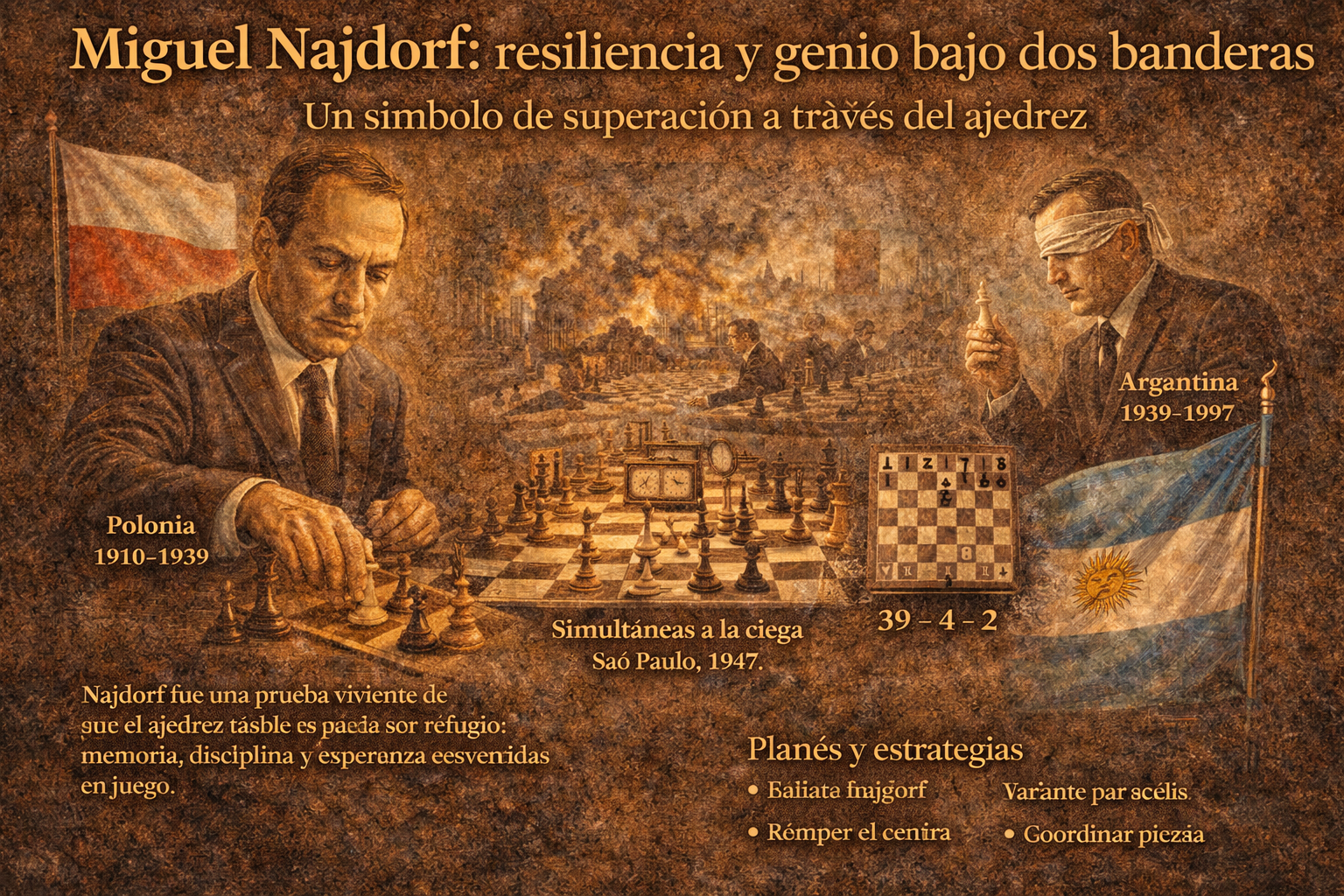
Najdorf destacó de manera especial por sus exhibiciones de simultáneas a la ciega, una modalidad que exige concentración y memoria de otro planeta. Su hazaña más célebre ocurrió en São Paulo (1947), cuando enfrentó simultáneamente a 45 rivales sin ver los tableros: ganó 39, empató 4 y perdió solo 2. Fue un récord que resonó durante décadas y que alimentó su mito.
Un legado duradero en el ajedrez moderno
Najdorf fue reconocido por un estilo audaz, dinámico y profundamente original, especialmente en aperturas. La Variante Najdorf de la Defensa Siciliana —que lleva su nombre— es testimonio permanente de su influencia en el ajedrez moderno. Campeones y súper élite la han empleado durante décadas como un arma de primer nivel.
Más allá del tablero, Najdorf fue un embajador incansable del ajedrez: comunicador nato, figura querida y referente cultural. Su historia funciona como metáfora del propio juego: cada decisión pesa, cada cambio exige adaptación, y aun en escenarios adversos siempre existe una posibilidad de reinvención.
Video recomendado (en español)
Ideal para complementar: contexto + legado + por qué su nombre sigue pesando en la historia del ajedrez.
Cierre
Miguel Najdorf falleció el 4 de julio de 1997 en Málaga, España. Su legado perdura como una fuente inagotable de inspiración: un recordatorio de que el tablero no solo refleja el ajedrez, sino también la vida—con desafíos, oportunidades y eternas posibilidades de triunfo.
Miguel Najdorf—born Mieczysław Najdorf on April 15, 1910 in Grodzisk Mazowiecki, Poland—stands among the most iconic figures in chess history. His life symbolizes the strength of the human spirit and an extraordinary ability to adapt and endure through the harshest circumstances.
Early steps in Poland
Najdorf discovered chess at a young age and quickly stood out for his tactical instinct and strategic feel. In interwar Poland, chess had strong cultural prestige, and Najdorf found in the game a perfect arena for creativity and intellect. His talent carried him into major national and international events, establishing him as a rising name in Europe. He was a contemporary of legends like Savielly Tartakower and Akiba Rubinstein, who influenced his approach and chess imagination.
War—and a life-changing decision
World War II became a tragic turning point. In August 1939, while playing in the Chess Olympiad in Buenos Aires, war erupted in Europe. Najdorf made the painful decision not to return home, understanding the mortal danger of Nazi occupation. That decision came with a devastating cost: the loss of his immediate family in the Holocaust.
In Argentina, Najdorf built a new life and became a central figure in Latin American chess. He gained Argentine nationality and, through charisma, resilience, and elite-level strength, earned admiration well beyond the chess community—becoming a symbol of perseverance.
The genius of blindfold simuls
Najdorf became famous for blindfold simultaneous exhibitions—an extreme test of focus and memory. His most celebrated feat took place in São Paulo (1947), where he played 45 opponents at once without seeing the boards: 39 wins, 4 draws, and only 2 losses. It was a record that echoed for decades and fed his legend.
A lasting legacy in modern chess
Najdorf was known for bold, dynamic, original chess—especially in opening play. The Najdorf Variation of the Sicilian Defense, named in his honor, remains a living testament to his influence on modern chess. Top champions and elite players have relied on it for decades as a world-class weapon.
Beyond the board, Najdorf was a tireless chess ambassador: a vibrant personality, a natural communicator, and a cultural reference point. His story mirrors the game itself—every decision has consequences, adaptation is essential, and even under adversity there is always room for reinvention.
Recommended video (Spanish)
A strong companion piece: context + legacy + why his name still matters in chess history.
Closing
Miguel Najdorf died on July 4, 1997 in Málaga, Spain. His legacy endures as a deep source of inspiration—reminding us that the board reflects life itself, filled with challenges, opportunities, and endless possibilities for triumph.